Digital Card Table
Welcome! Select one starter pack of your choosing and take 2-3 minutes to quietly read each card in your pack. Then, select one card and reflect:
How does this concept show up in my teaching?
How might I center it more deeply in my design, my practice, and my relationships with students?
How is generative AI impacting this concept in the classroom?
Starter Pack: Building Community
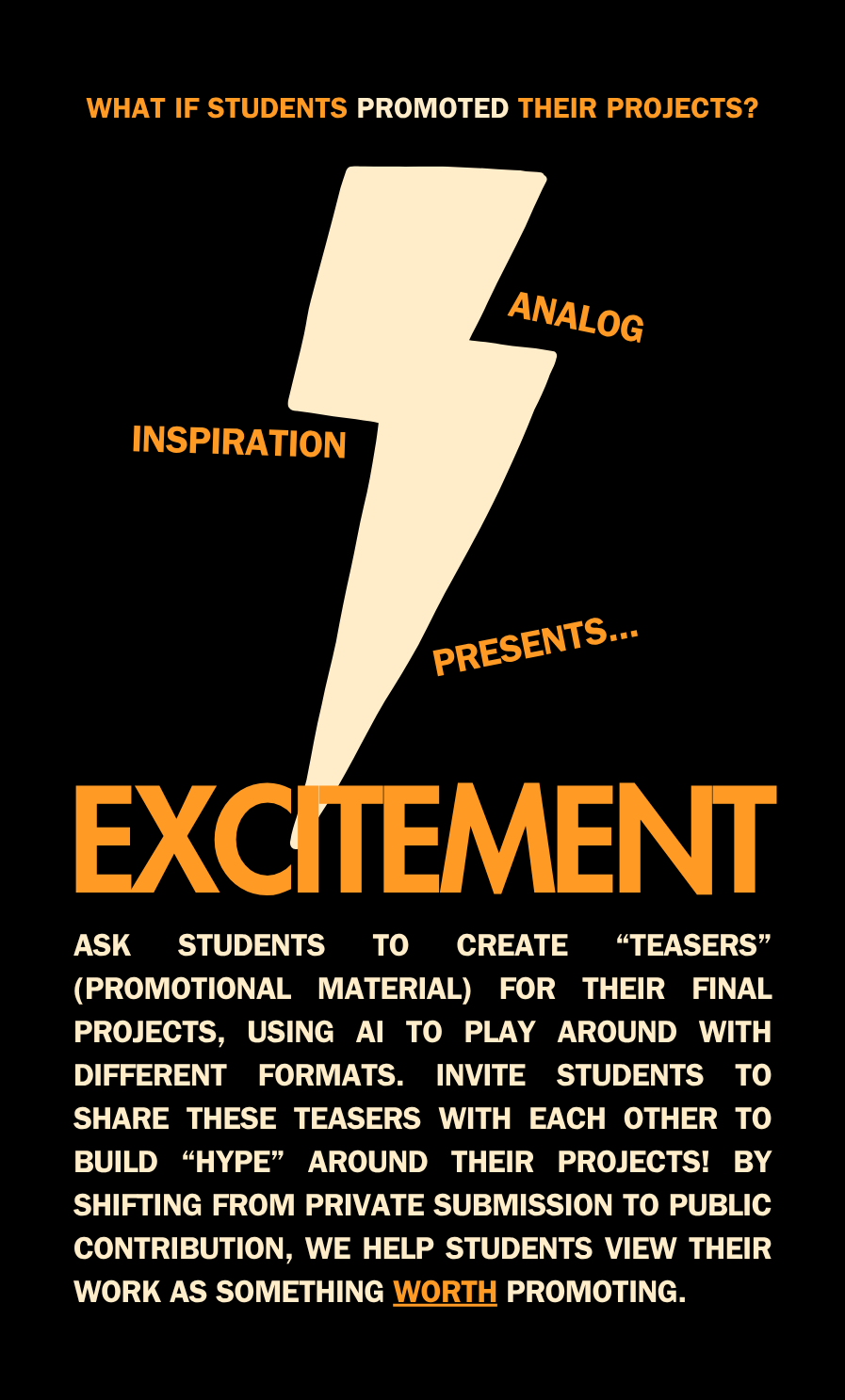
Excitement: What if students promoted their projects? Ask students to create “teasers” (promotional material) for their final projects, using AI to play around with different formats. Invite students to share these teasers with each other to build “hype” around their projects! By shifting from private submission to public contribution, we help students view their work as something worth promoting.
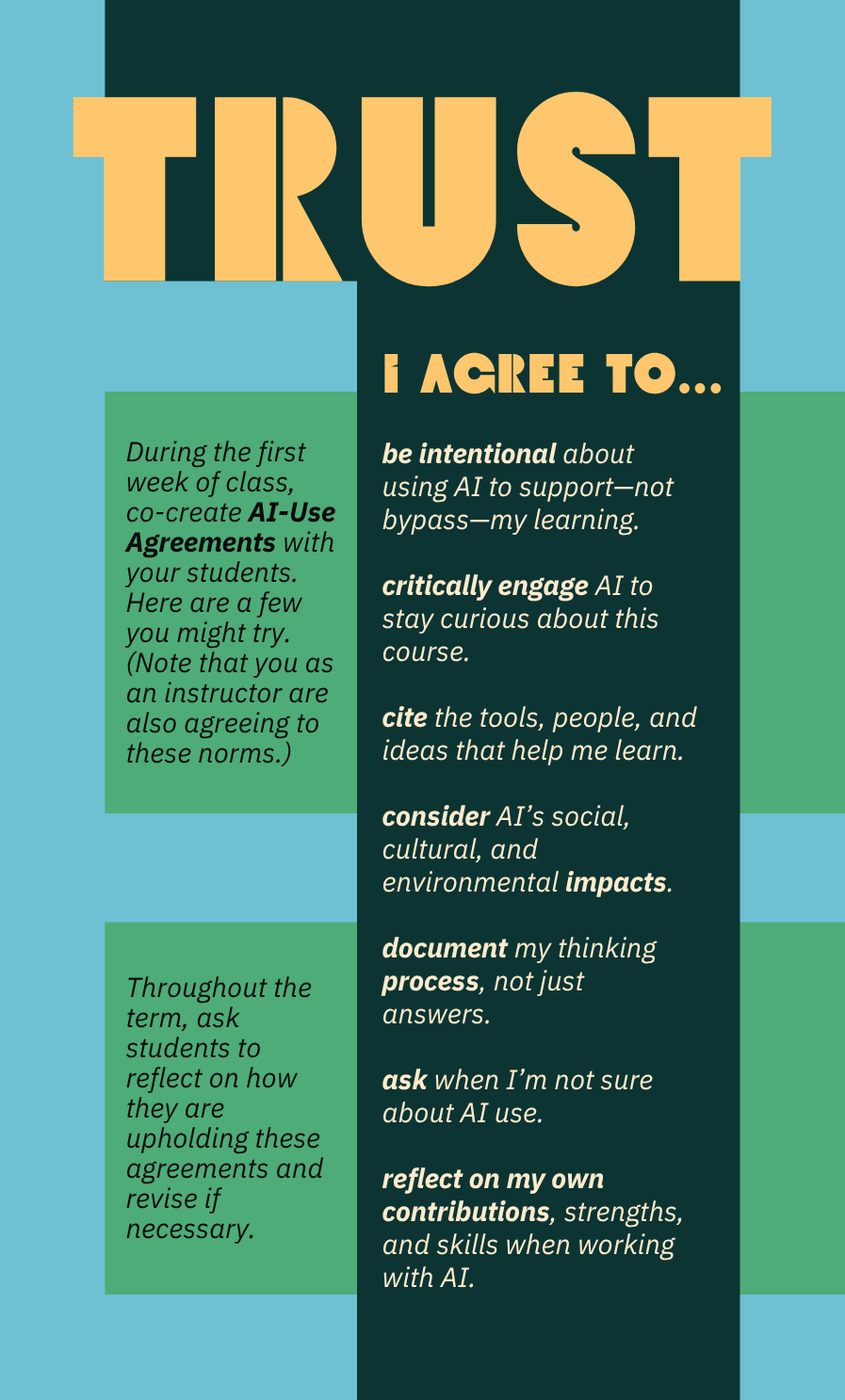
Trust: During the first week of class, co-create AI-Use Agreements with your students. Here are a few you might try. (Note that you as an instructor are also agreeing to these norms). I agree to be intentional about using AI to support—not bypass—my learning. I agree to critically engage AI to stay curious about this course. I agree to cite the tools, people, and ideas that help me learn. I agree to consider AI’s social, cultural, and environmental impacts. I agree to document my thinking process, not just answers. I agree to ask when I’m not sure about AI use. I agree to reflect on my own contributions, strengths, and skills when working with AI. Throughout the term, ask students to reflect on how they are upholding these agreements and revise if necessary.

Humor: Ask AI to generate funny analogies or memes for a tough concept or topic in your course. Invite students to critique them, build on them, and share their own memes with each other.
Starter Pack: Critical Thinking
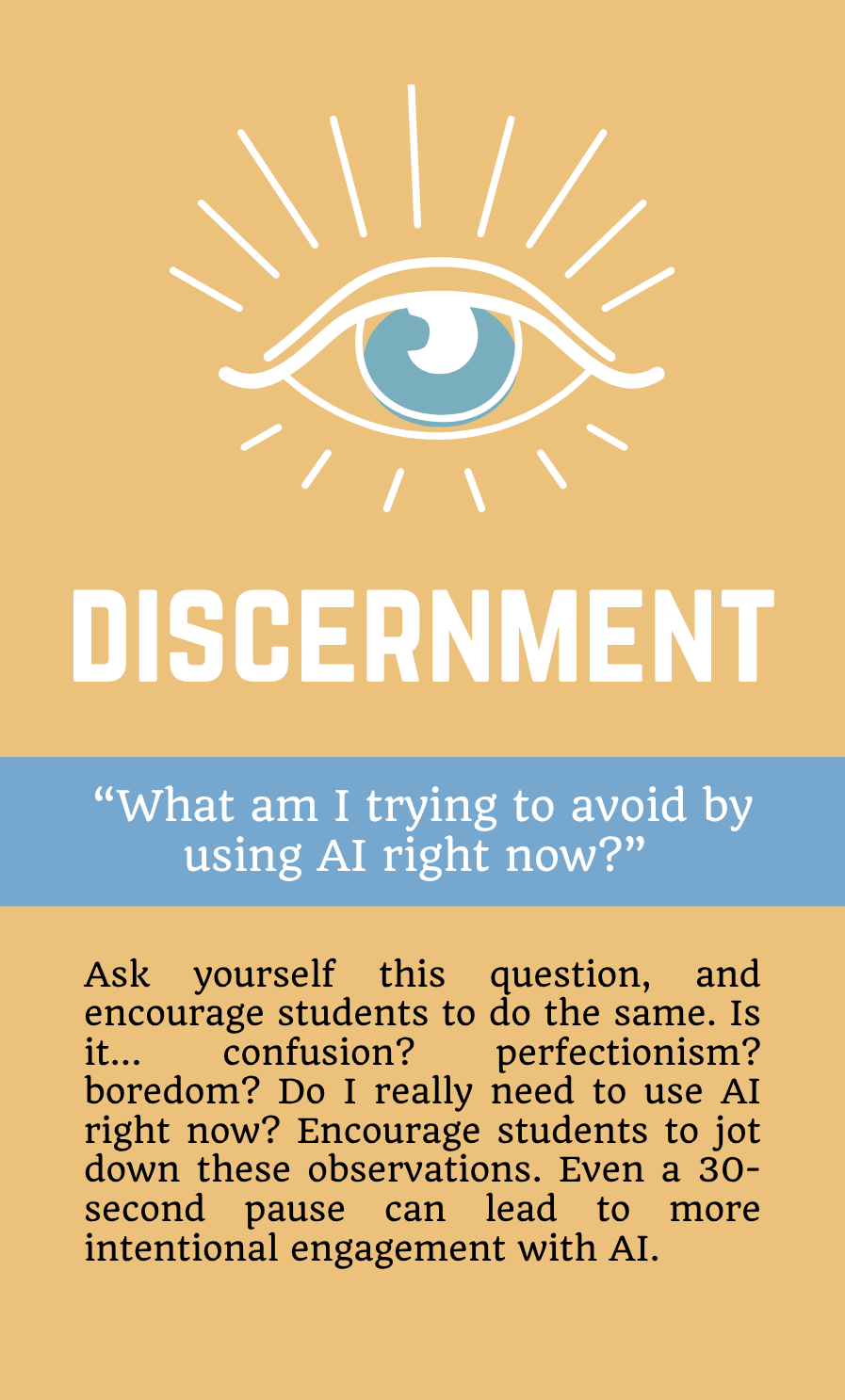
Discernment: “What am I trying to avoid by using AI right now?” Ask yourself this question, and encourage students to do the same. Is it... confusion? perfectionism? boredom? Do I really need to use AI right now? Encourage students to jot down these observations. Even a 30-second pause can lead to more intentional engagement with AI.
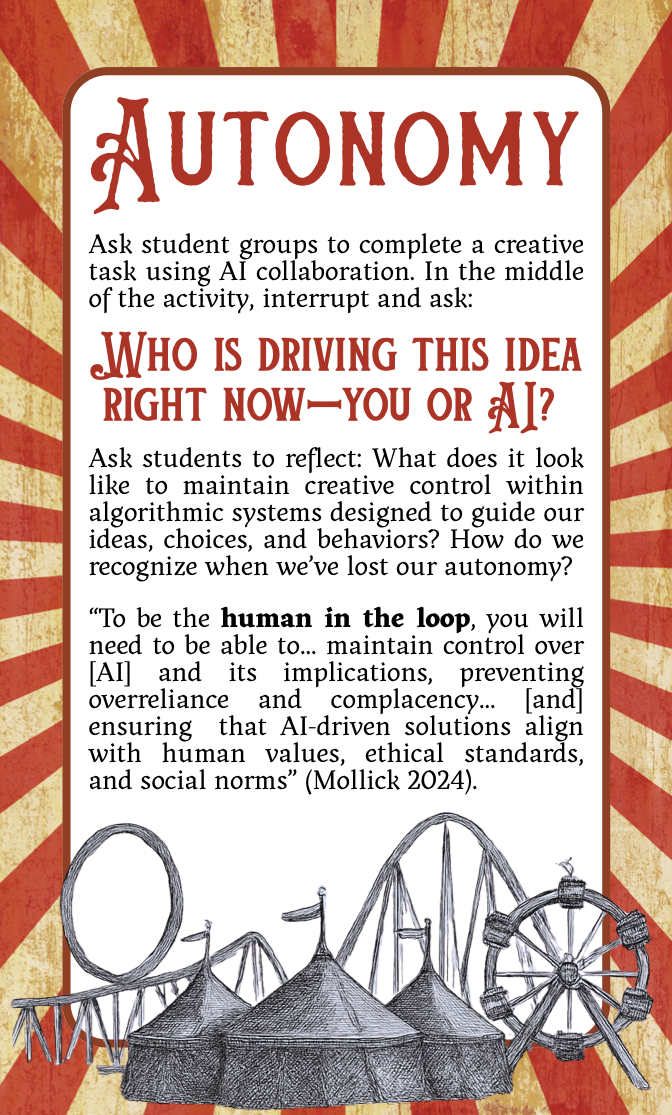
Autonomy: Ask student groups to complete a creative task using AI collaboration. In the middle of the activity, interrupt and ask: "Who is driving this idea right now—you or AI?” Ask students to reflect: What does it look like to maintain creative control within algorithmic systems designed to guide our ideas, choices, and behaviors? How do we recognize when we’ve lost our autonomy?“ // To be the human in the loop, you will need to be able to... maintain control over [AI] and its implications, preventing overreliance and complacency... [and] ensuring that AI-driven solutions align with human values, ethical standards, and social norms” (Mollick 2024).
Perspective: Ask students to share their working thesis, hypothesis, or project pitch with AI and ask it to point out stakeholders, variables, counter-arguments, or other things they’ve overlooked. Students can then revise their work to address these gaps, reflecting on how these perspectives have impacted their own.
Starter Pack: AI Ethics
Bias: AI Auditors: Ask students to read about AI’s encoded biases. Invite them to experiment with tools to expose errors, find inconsistencies, and uncover assumptions, especially as they relate to their discipline. What kinds of vernacular are used in specific contexts? What perspectives are missing from outputs? What do image generators assume with their depictions? Invite students to share their audits and findings with their peers.“ // If we do not acknowledge and teach the hidden curriculum of AI, and the ways schools offer fertile ground for its uncritical and at-scale implication, we risk perpetuating the encoded bias and ideologies of oppression which are baked into its design” (Warr and Heath 2025).
Truth: Truth Trails: Ask students to pause before accepting AI-generated claims, answers, images, or citations. Stage a class investigation to determine whether a video is AI- or human-generated, or, invite students to “follow the trail” of a course-related AI-generated output. This can involve verifying sources cited; finding sources that cite those sources; locating the page numbers of quotations; analyzing competing accounts, theories, and discourses around the topic; and identifying AI assumptions and hallucinations. Ask students to visualize their “truth trail” as a web, map, flowchart, or annotated path.
Sustainability: Invite students to use interactive tools like what-uses-more.com (Ippolito 2025) to keep a daily or weekly digital energy journal. Ask them to compare AI use with their larger digital media footprint. Challenge students to brainstorm together: What policies, regulations, and actions are necessary to address the environmental costs of the data centers that fuel this technology?
Starter Pack: Self-Care
Rest: Carve out a 15-minute break • take a nap • drink some water • remind your students to do the same • we are more than what we produce. Don't use AI today. Let the Earth rest.
Light: Amid the many concerns around AI, learning, and the future of the world, take a quiet moment to reflect: What is it that brings light to your teaching? When does teaching feel joyful, meaningful, and alive? Jot down some notes and paste them into AI. Ask for a few ways you might bring more of this light to your classroom.
Compassion: Prompt AI: “Give me three examples of compassionate course policies.” Compare them with your own. Then, compare both AI’s and your own policies with those of a peer: What’s different? How might these policies present challenges for our own well-being as faculty? How can we design for compassion, both for our students and for ourselves?
Starter Pack: Assessment
Friction: Try to complete one of your own assignments using AI to completely bypass learning. What changes could you make to the assignment to introduce new complexities or moments of productive friction? “In the age of AI, we're going to have to decide when we want to use these tools, when they remove productive friction, and even when they may bring new and useful friction to the process” (Rosenzweig 2024).

Growth Mindset: After a quiz or assignment, ask students to choose one question or section they struggled with. Invite them to use AI to explore what they misunderstood and how to improve it. Students can then write a brief reflection and resubmit it along with the revised work for credit, normalizing the idea that mistakes, evaluation, and iteration are essential parts of learning.
Authenticity: Share your learning outcomes with AI and ask for three distinct authentic assessment ideas that align with those outcomes. Specify that the assessments should emphasize real-world application and mirror the kinds of tasks, scenarios, workflows, events, and deliverables that students may encounter in their professional and personal futures.